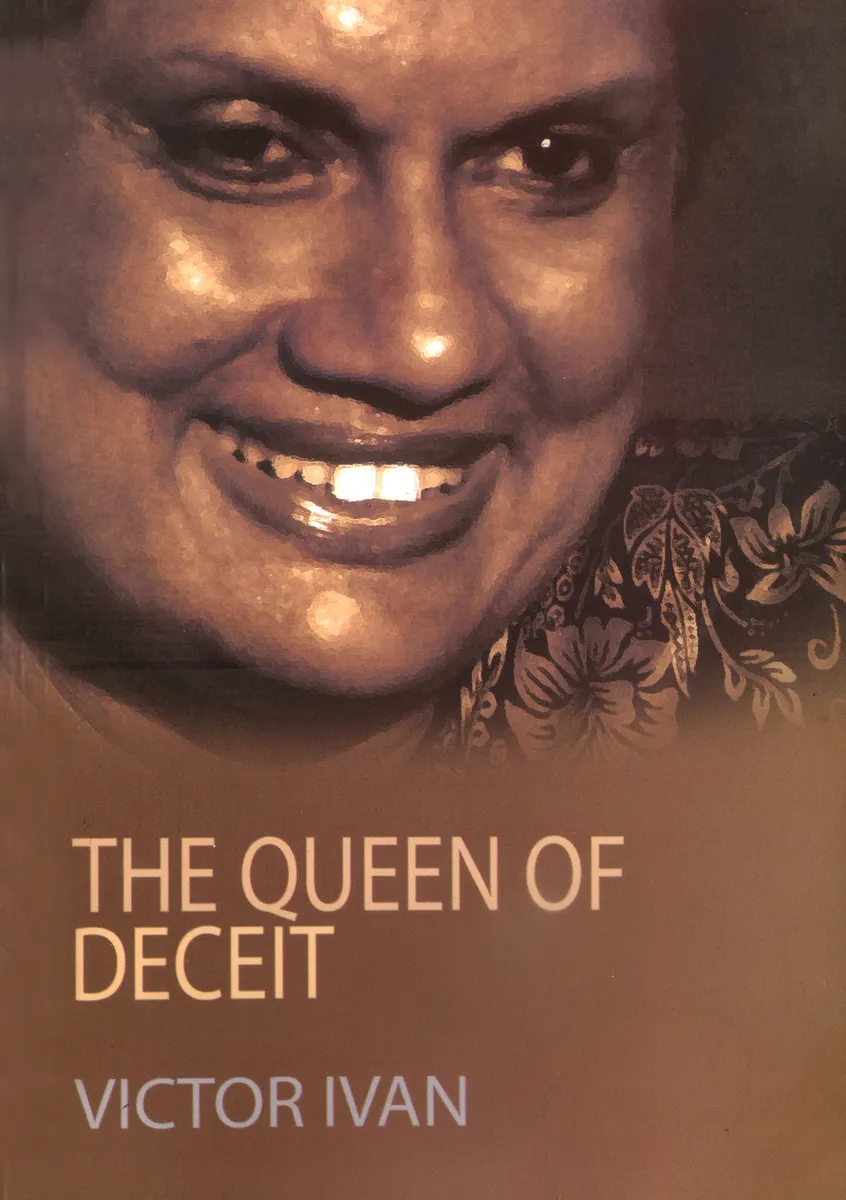
Chaura Rajina – Fact or fiction?
"It was the warm blood continuously shed on this land that propelled her to power. Tears shed for lost husbands and sons, shed by this country's widows and mothers; they provided the fuel for her political journey....yet after she ascended power she promptly forgot the innocent, fair aspirations of the people that took her there."
- Chaura Rajina by Victor Ivan, Published by Ravaya Publishers 2006
If ever there was a journalist's account of the tenure of a leader who had fallen hard from grace, that would be Victor Ivan's Chaura Rajina or 'Queen of Thieves.' Tracing the history of Chandrika Bandaranaike Kumaratunga from 1994 to 2005, when she vacated the position as Head of State, Queen of Thieves is a damning indictment on a controversial modern political leader. The book released less than an year after Kumaratunga's retirement implicates the former President in a series of crooked deals and assassinations, and even floats a theory that the Town Hall bomb explosion two days before the 1999 presidential election in which she lost an eye, was a set up to win public sympathy and keep her in power for a further six years.
The Ravaya Editor describes in detail how feared underworld figures, like Baddegana Sanjiva were nurtured at President's House during Kumaratunga's regime, and assigned the task of harassing and in some cases 'taking out' her political opponents and detractors.
To be an actual expose of a corrupt Executive however, the arguments presented in Chaura Rajina are seriously lacking in basis and fact. Most of the book's startling revelations are often little more than vague hypothesis and little less than circumstantial evidence. One glaring example of this was in the Chapter relating to the assassination of Kumar Ponnambalam in 2000. The writer holds President Kumaratunga culpable in this on the grounds that a letter addressed to Mrs. Ponnambalam, expressing her condolences was dated May 6, 1999, when the assassination had in fact taken place on January 5, 2000. The President had later written a letter of apology, correcting her mistake and explaining that she was strapped for staff because of a curfew that had been imposed and the letter had been dated incorrectly. The author then refers to an article published in Ravaya, alleging that Baddegana Sanjiva and Moratu Saman had killed Kumar Ponnambalam.
According to the Ravaya Editor, the newspaper had also received a phone call from a woman who wished to remain anonymous, saying that she overheard a conversation between the assassins, in which they vowed to keep the victim's mobile phone as a souvenir. The phone had been thrown in a canal after the article was published in the newspaper, Ivan writes. Several other recorded conversations and confessions have been published in full in both Ravaya and another English weekend newspaper, the author says. However, neither transcripts nor excerpts from those articles have been republished, however, to provide a greater degree of clarity, leaving the reader by and large befuddled with the scores of allegations and counter-arguments presented.
The book reveals how she used the Presidential Security Division as her personal Mafia – utilising them to strike fear in the hearts of her opponents and harass those she needed 'controlled.' There are also accusations of filling the PSD up with characters of dubious repute and in some cases, well known underworld personalities. The problem is, none of this is news to the Sri Lankan public. All this has been hashed and rehashed in local newspapers and were public secrets during her tenure. To have an impact, the stories had to be accompanied by the presentation of rock hard facts. A journalist by profession, the author must at least know that. The only photo in the book to substantiate the claim is one of the President on stage, with Baddegana Sanjiwa among the PSD officers providing her security. Ivan refers to him in the caption, as her 'pet murderer.'
Ivan levels a severe criticism against Chandrika's Patek Phillipe watch which cost well over 2 million rupees, whereas J.R. Jayawardene's much criticised Rolex watch cost only 300,000 rupees. While it was not certain whether the author took inflation into account in making the comparison, he claims that the watch had been a gift from a foreign dignitary and once this was revealed in the media, Kumaratunga handed over the watch and several other gifts received in the same manner to the Treasury, as should have done in the first place.
Then he dedicates an entire chapter to analyse Chandrika's political and personal relationship with actor turned politician Sanath Gunathilake. Beginning with his culpability in the Channel 9 deal to intensely personal details about his sexual orientation, Ivan analyses and questions all this in detail. However, the reader is baffled and disturbed by the personal jabs made at the actor about his conduct with former prominent political leadership like late Gamini Dissanayake, late president Ranasinghe Premadasa and finally Chandrika Kumaratunga. It is insinuated that Gunathilake sought the company of these individuals with the expectation of achieving political glory and acquiring wealth. The account of his misconduct stretches from granting liquor licences to his henchmen, acquiring illicit wealth including a home in England and running an advertising agency and channelling government advertising through it. All these are elaborated in detail and at the end of the Chapter, Ivan compares Gunethillake's tactics to Machiavelli's ideal politico:
"Had Machiavelli been alive today, no doubt he would praise Sanath the way he praised Cesare Borgia. If Sanath were to write his life story truthfully, not only become a best-seller it would replace Machiavelli's 'Prince' in terms of significance no doubt."
-Chapter IX – Sanath Gunethilake
The most scathing and disturbing accusation that Ivan levels at Chandrika is presented in the second chapter where he deals with the 1999 Town Hall bombing two days before the presidential election where she sustained minor injuries to her eye. He says that the incident was planned and carried out by herself to attract sympathy votes because she was not expected to get the chance to serve the second term in office due to her poor administrative skills and disappointing governance. The author points out that the although Kumaratunga had sustained a serious injury in the explosion, that was not part of the original plan allegedly cooked up at President's House. Ivan quotes a statement Kumaratunga had made to a ballistics expert in hospital, where she said she would have been safe had the bomb-proof car been one inch higher. The expert had been charged with travelling to Germany to provide the BMW plant there with the specifics to build a car for the former President that would withstand certain types of explosions. The author also cites a comment made by former Defence Minister Anuruddha Ratwatte who having initiated an inquiry into the Town Hall explosion had been told by Kumaratunga not to meddle in matters that do not concern him. According to Ivan, the manufacturing order by the Ballistics expert, the expert's countenance when confronted with this theory by the author himself in later years and Kumaratunga's comment to her uncle, Gen. Ratwatte, (and a convoluted tale about a Tamil prisoner in Boosa being hired for the night) make up the bulk of the argument for the notion that something fishy had taken place with regard to the bombing.
Naturally then, the reader concludes that the incident, as presented in the text is based mostly on hearsay and not hard evidence. Even the facts seem to be unsubstantiated and baseless.
Through all the chapters in the book one thing is very stark – that in an attempt to sensationalise and 'expose' certain say, 'suspicious' aspects of President Kumaratunga's term in office, Ivan has succeeded in creating the impression of giving vent instead to a personal vendetta against the personality in question.
For Victor Ivan, by his own admission, in Chaura Rajina, assisted Chandrika Kumaratunga's effort to attain the highest position of the land. His disillusionment, therefore, with her political degradation comes through in the book very strongly. There is bitterness in his words that do not sit well in this kind of expose of a contemporary politician. His account of her misdeeds may have had a greater impact with a local readership if he had been able to distance himself from the personality and her background.
Dharisha Bastians and Vindya Amaranayake
The Nation
24 September 2006
View original ↗
A Landmark in Sri Lankan Political Writing
It's hardly surprising that Victor Ivan's 'Chaura Regina' has become the number one bestselling book in Sri Lankan publishing history. It's a book that's difficult to put down once you start reading it. Virtually everybody that I met after returning to Sri Lanka had either read it, or were anxious to get their hands on a copy. Even the class that usually never reads Sinhala books or newspapers, wanted to read this. The Ravaya printing press apparently couldn't keep up with the demand.
This is a political biography like no other. The only other book like this that I know of, is the reply written in the early 1990's by the Gamini Dissanayake-Lalith Athulathmudali faction in the UNP to Bradman Weerakoon's biography of President Premadasa. Entitled 'What Bradman didn't Write', it revealed a whole lot of juicy details which were lapped up enthusiastically by the public. But where these two books differ is that 'What Bradman didn't Write' was authored anonymously, and there was no one whom we could talk to and hold accountable for what was said. But here we have Victor Ivan, penning a no less shattering indictment about Chandrika, under his own name.
Victor Ivan is eminently qualified to write a book about Chandrika Kumaratunga, because he was one of the people who went out of their way to bring her from the political wilderness back into the SLFP, and then to stand behind her until she made it into power. His newspaper, Ravaya was thrown into the effort and was virtually Chandrika's official newspaper by 1993. As Chandrika's popularity grew, so did the Ravaya circulation. It was a mutually beneficial relationship. Chandrika benefited politically from the publicity she got from Ravaya and the newspaper benefited from being perceived as the mouth piece of the rising star of the Sri Lankan political scene.
Victor Ivan went out on a limb for Chandrika before she came into power. When Chandrika once established in power, started doing the things described in this book, one of the main casualties of the fallout was Victor Ivan himself. The circulation of Ravaya dropped precipitously and was never able to recover the peak of 1993/4. Ironically, despite the Chandrika debacle, in subsequent years Victor Ivan has managed to enhance his personal stature as a leading Sinhala journalist in the country, a newsmaker and civil society figure in his own right, yet his newspaper remains but a shadow of its former self.
Understandably, his bitterness at what Chandrika turned out to be, once established in power, is reflected in his book. After the Wayamba Provincial Council elections which were held amidst unprecedented violence, Ivan wrote furiously, "After this, the People's Alliance has no right to speak of democracy. They have no right to talk of devolution of power. They cannot speak of the UNP's terror (bheeshanaya). They cannot speak of transparency. They cannot speak of a white-lotus like, unsullied rule. To the ordinary public who have no fixed party affiliations, the People's Alliance would now appear as a den of thieves who masqueraded as democrats in order to get into power and to suck the country dry." Strong words indeed, especially considering the fact that they were penned just over three years into the Chandrika Kumaratunga administration.
Around that time, I asked Victor Ivan why he chose to promote Chandrika Kumaratunga as against Lalith Athulathmudali, who parted company with the UNP in 1991. Clearly, Lalith was the superior politician and Victor Ivan was known to be close to him as well. Ivan's reply was that the country needed a change after so many years of UNP rule and even though Lalith was the better of the two in every respect, as a leading figure of the ancient regime he could not provide the change that was needed. And in any case, the assassination of Lalith Athulathmudali in April 1993, left Ivan with little choice.
Another criticism that Victor Ivan levels at Chandrika is that though she ruled the country for eleven years, she has not done anything of lasting value for the country. In this context, around ten years ago, I remember standing in front of the Upali Group Headquarters at Bloemendhal Road, talking to a staunch supporter of the People's Alliance when he pointed to the Sugathdasa Stadium (built by Premadasa) and said "Even if Chandrika rules this country for fifty years, she cannot complete one of these, yet we support her." My PA friend proved to be correct. Chandrika came and went with nothing tangible to show for her years in power.
A claim she was fond of making even towards the end of her rule was that it was she who restored democracy to Sri Lanka. But as Victor Ivan has pointed out, with the ending of the JVP's second insurrection in 1989, and the rise of alternative newspapers, the split in the UNP with Lalith Athulathmudali and Gamini Dissanayake joining the opposition, and the subsequent elevation of the mild mannered and benign D. B. Wijetunga to the Presidency, had restored democracy to the country and Chandrika had played no role in the process. Chaura Regina is a story about the rape of a nation. It makes compelling reading and should be read by every Sri Lankan.
Some of those who read it told me that the story that Chandrika got her political mafia to plant the Town Hall bomb in order to get the sympathy vote, sounds a little far fetched. The injury to her eye, was not part of the plan, but was caused by a miscalculation according to Ivan. Even I was inclined to give the benefit of the doubt to Chandrika on that one. Yet the events recounted by Victor Ivan do plant the seeds of suspicion even in the most skeptic mind. Chandrika was the complete political animal and not beyond doing the most unlikely things - things that other people would not do - for political gain. I never could understand how she could institute a commission of inquiry into the assassination of her husband Vijaya Kumaratunga, simply to foist the blame on the then Prime Minister Premadasa, when she knew as well as we did, that it was the military wing of the JVP that killed Vijaya. To her, what to was important was to score points get some political gain from even her husband's assassination - which in this case was to curry favour with the JVP constituency. What would people have thought if Mrs. Sirima Bandaranaike had let off Somarama and Buddharakkhita and tried to blame Dudley Senanayake for SWRD's assassination? Beyond any doubt, Chandrika was a very cynical leader. Nothing was sacred to her, except political power.
C. A. Chandraprema
Sunday Island
17 December 2006
View original ↗
Mahinda can put Choura Rajina to good use
The Free Media Movement (FMM) has taken umbrage over ex-President Chandrika Kumaratunga's request to President Mahinda Rajapakse to ban Ravaya Editor Victor Ivan's latest book, Choura Rajina (Rogue/bandit Queen), which levels serious allegations of corruption, political assassinations and gross abuse of power against her regime. The book also alleges that she orchestrated the bomb attack on her in 1999 only to be hoist with her own petard.
FMM has complained to UNESCO, where she works as a senior advisor, that her move to ban the book contravenes the principle of freedom of expression which the UN upholds. Earlier the Asian Human Rights Commission (AHRC) urged UNESCO to strip her of the new post on the grounds of the allegations in Ivan's book.
Ms. Kumaratunga has asked the government if it could ban the screening of Da Vinci Code why it couldn't ban Choura Rajina. She has failed to realise that the banned film is considered an attempt to vilify the Catholic Church as a whole while the book at issue deals with purely mundane matters with the intention of naming and shaming an individual politician.
Sri Lanka is notorious for bans. Hardly a day passes without a ban on something being slapped. Recently, a ban was imposed on wayside parking in Colombo and another ban on smoking in public places is to take effect shortly. Sale of liquor and meat is banned on certain days. So, Ms. Kumaratunga may have thought of seeking a short-cut by calling for banning the book. (A wag says she seems to have problems with books. The much advertised 'CBK' by a kilted writer too proved to be a disaster! Though intended to be her biography, it ended up being stranger than fiction.)
Paradoxical as it may sound, bans are the best way to promote a book or a movie. Get any mediocre book banned and it will start selling like hot cake or unu kevun. Sri Lankans are a curious lot and they cannot resist the temptation to see what they are not supposed to see. Look at the way they flock in their thousands despite security cordons to have a glimpse of a suspected bomb. If Choura Rajina were banned by any chance, the author/publisher would become a multi millionaire overnight on the sales of the book alone.
It is not likely that President Rajapakse will ban the book. Having drawn the flak over the Da Vinci Code, he may not want a repeat performance in quick succession. On the other hand, what is poison to Ms. Kumaratunga may be meat to President Rajapakse, whose political future she went all out to destroy in the run up to the presidential election by colluding with his main contender. Instead of banning the book, he might consider contributing an additional chapter to it.
It will be a mistake for Ms. Kumaratunga to campaign for a ban as it smacks of an attempt to dodge the allegations the book contains. Whether the people have taken them seriously or not, one doesn't know but being a former Head of State, she ought to call for a probe into them with a view to allaying the doubts in the public mind and clearing her name. That is the best way to put the matter to rest.
Interestingly, the allegations against her emanate from her erstwhile chums who helped her become President, while she is being defended today by her former enemies who went all out to bring about her downfall through a sustained vilification campaign. (Not to be outdone, it may be recalled, she heaped abuse on them at every turn.) We thought it was only in politics that there were no permanent friends or no permanent enemies. But, journalism appears to be no different from politics. O tempora, O mores!
The bitter experience of Ms. Kumaratunga should serve as a lesson for her successor. An Executive President may think, like JRJ, that the only thing he or she cannot do with his or her unbridled powers is to make a man a woman and vice versa. But once out of power, they all become, as the saying goes, bananas without the skin—pecked by all political crows.
President Rajapakse could put Choura Rajina to good use. He should keep a copy of it in his bed room to read himself to sleep every night so that he will ever be mindful of the fact that he is being watched just like his ban-seeking predecessor and the executive presidency is only a borrowed garment.
The wise learn from the mistakes of others.
Editorial, The Island
The Island
25 November 2006
View original ↗