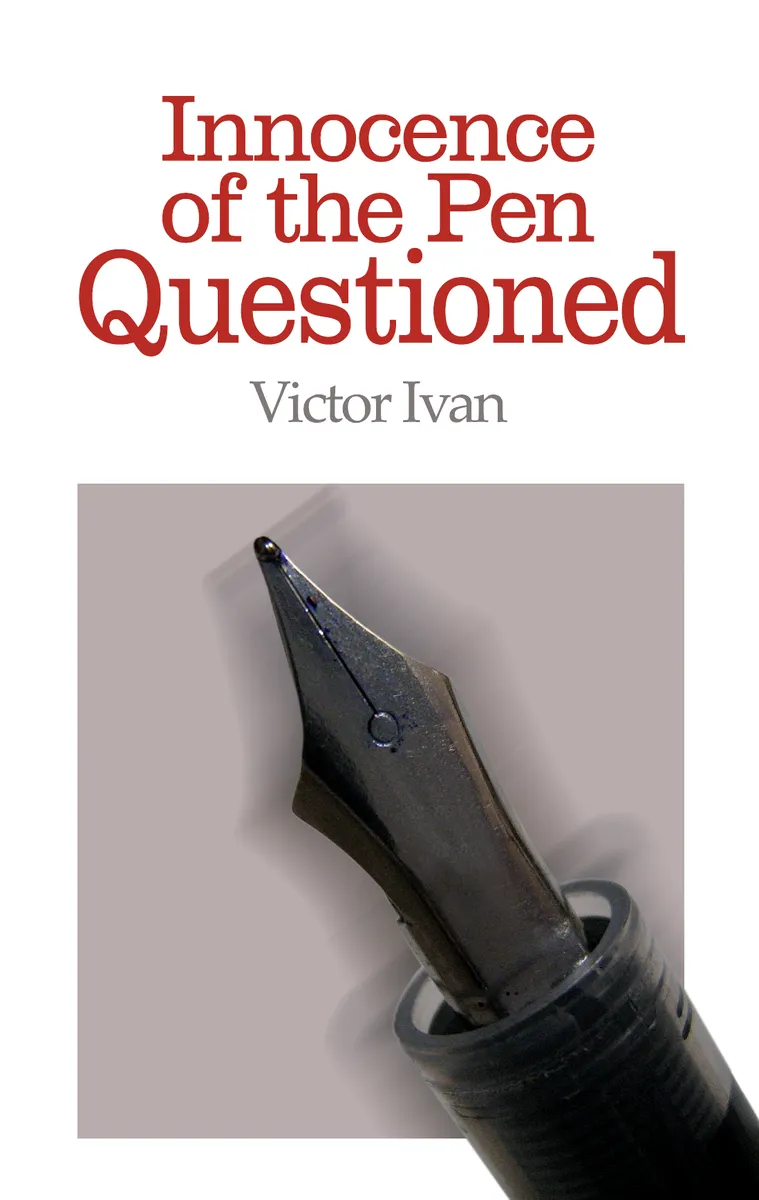
Media in the dock – 'Innocence of the pen questioned'
Victor Ivan's new book "Innocence of the pen questioned" (Ravaya publication, Sept. 2010) makes its appearance at a crucial point in time in the trajectory of Sri Lankan media and politics. During a phase when both the media and the political system are struggling to adjust to the new realities of a post-war situation, the contents of this book are likely to re-ignite intractable debates surrounding these subjects. Ivan's intensity and candour in setting down his thoughts invest the book with a no-holds-barred quality that makes it a riveting read. More importantly, the views expressed, subjective and individualistic though they may be, would hopefully initiate discussions towards the creation of a media culture that is more honest and self-critical. (This is in fact a stated objective of the book)
'Innocence of the pen questioned' dwells on several aspects of Ivan's own journalistic experience, including but not limited to Ravaya, the newspaper he founded and owns and edits. In this sense it is largely anecdotal. But this material is always related to larger social and political realities, the author's conviction of the need for change at broader systemic levels, and questions relating to the journalist's role in society.
In the process of talking about his own experiences, Ivan raises some key issues that bedevil the Sri Lankan media scene. It would appear that these issues have not been subjected to public scrutiny for complex reasons. Perhaps partly owing to the risky circumstances that prevailed during the war, and the dangers involved in naming names and relating stories. Ivan however names names, and relates stories, and does so in detail. As a result he (and the book) will be vilified by some, and praised by others. Herein lies the courage of his enterprise.
One of the important questions raised is, whether or not the journalist should engage - as an actor - in politics. Ivan has by his own admission played this "king making" role in recent Sri Lankan politics. He describes in some detail his work as the chief architect of the SLFP's publicity campaign during the 1994 general elections, as well as an image-building exercise relating to Chandrika Kumaratunga, that contributed to her rise in the political firmament at the time. Kumaratunga went on to win the presidential election that year.
"A question however remains whether a media person could appear for a political objective or not. It is a controversial issue," he writes. He raises this vital question and comes to the verge of addressing it, but does not proceed. This is unfortunate, seeing that Ivan would have been well placed to lead such a discussion, having 'been in the belly of the beast,' so to speak. But he does discuss and compare his involvement with politics with that of the late Sunday Leader editor Lasantha Wickrematunga who, he says, strove to bring a UNP government led by Ranil Wickremesinghe into power. Ivan goes on to speculate on reasons why he escaped the grisly fate of his colleague.
Another area subjected to extensive discussion in the book relates to the activities of media NGOs, and the whole question of media freedom. In his writings elsewhere too, Ivan has highlighted peculiarities of the organization called the Free Media Movement. Here again, having been a founder member who has now parted company with the group, he is well placed to critique it. He questions its cliquishness as well as its lack of transparency.
Ivan's discussion prompts the question as to why media NGOs like FMM are wary of opening their membership and decision-making committees to the broader community of professional journalists. Is it because independent minded journalists are inclined to ask questions (Where's the funding coming from? What's the donors' agenda, etc.?) One of the criticisms he makes of the FMM is that the foreign aid it received was contingent on its adopting an ideological stance opposed to the war - "consequently their political stance had become an income source for them to earn money," he says. This situation hampered the outfit's ability to make "an impartial and correct assessment of the war," he argues.
It is no secret that scribes in Sri Lanka had to carry out their duties in a most uncongenial environment, fraught with multiple dangers during the decades of conflict. Ivan describes in some detail, cases where journalists were threatened, intimidated, assaulted or killed. He shows that not all these violent incidents could be blamed on the government or security forces, but that the FMM unfailingly portrayed them as such. There was a lack of interest in investigating the background to these incidents, and as a result the true picture was often not revealed. Among these victims were:
1) journalists who were attacked for doing things that could not be described as falling within their call of duty
2) journalists who were attacked for doing things that advanced their political agendas (in this category were LTTE activists claiming to be media persons)
3) journalists who exploited the volatile situation for personal gain, using political asylum as an easy way to go abroad
Among these categories were bona fide journalists as well as persons whose media credentials were dubious or non-existent. The author illustrates this with anecdotes from his personal experience.
Ivan's argument is that none of these cases could strictly be considered as attacks on media freedom. Yet all of them were uncritically seized upon by the FMM. Again, he hints at the corrupting influence of large injections of foreign funds. "The Free Media Movement presented itself as a movement of media freedom," he writes. "At the same time, it received foreign aid for this project. In 2008 alone, it received foreign aid to the tune of over Rs.10 million for various projects. It had received a substantial amount of money by way of foreign aid to ensure the safety of the media people. Perhaps, they may have exaggerated the situation of the country painting a dismal picture with the view to obtaining an increased share of foreign aid for the movement."
Ivan is critical of the conduct of individual journalists as well as the media organizations. Perhaps the biggest disservice to the journalist community resulting from the media organizations' misrepresentation of the media landscape is that when a real journalist somewhere actually does get intimidated or attacked by state agents, it is met with public apathy and skepticism. Ivan highlights the need to restore public confidence in the media as an urgent need. He makes a number of recommendations to this end.
The book may have some stylistic flaws, and tends to be rambling and repetitive in parts. Love it or hate it, its value lies in its underlying honesty. It's a "must read" for journalists, ex-journalists, wannabe journalists, charlatans and hucksters alike ...
Lasanda Kurukulasuriya
The Sunday Times
21 November 2010
View original ↗
Lessons for corporates from Victor Ivan's book
Investigative journalism is a particular type of reporting in the media that can usually drive fear into the hearts of the subject of investigation.
In my early days as a journalist I have worked on the investigation desk of many newspapers.
A journalist on an investigation desk usually thinks himself to be a cut above the rest in the editorial; presents himself as a kind of 'special ops guy', a man/woman with that peculiar nose which can ferret out all sorts of wrong doings. Sometimes, placing himself way above the normal operating procedure of the editorial, even thinking that he can stretch the rules or bend them to achieve that particular goal which is to get a scoop.
This type of journalism became most popular after the Watergate scandal when Woodward and Bernstein used all sorts of methods to expose the misconduct of an American president which ultimately led to his resignation.
But what exactly is Investigative Journalism? I never really dwelt that much on the makings of it until I stumbled upon Victor Ivan's recent book "Innocence of the Pen Questioned". Victor is a senior journalist, a man whose pen has been mighty. He has exposed many situations for the good of the community and as I read through this book which starts with a bit of history of the Ravaya newspaper (of which he is editor), I discovered that it took a turn in Chapter II, which bears the headline 'Investigative Reporting'. He breaks down Investigative Journalism and gets to the core of what this brand of journalism actually is.
For me as an ex-journalist, it was particularly fascinating to see how he analysed it, and why I dedicate this column in a business publication to this subject is because this book is a 'must read' to those who interact with the public and media on a day to day basis.
As I picked up the phone and spoke to him about the book, I figured out one thing, that investigative journalism does not exist for 'muck raising'. It is a special technique in the media profession, something similar to surgery in medicine; something that has to be handled with care and a lot of respect.
"Disclosure of good news (uncovering of an offence of public importance which was kept hidden from public knowledge) that may lead to arouse public sensation, cannot always be treated as investigative reporting" says the book which is exhaustive in its study of the various nuances in this stream. "Essentially, investigative reporting does not imply mere reporting of who, what, when and where: it is rather telling your reader / listener about how and why a thing had happened, after making an in-depth analysis of it." Victor says.
"Investigative reporting is to explore and uncover the facts which were deliberately hidden in violation of ethical and legal norms. In doing so, the investigative reporter will be able to open the mouths which were shut and the doors that were closed."
Why understanding this kind of reporting becomes important to the business world is because one can easily find oneself in the middle of some adverse media attention. This understanding can prove invaluable when one is struggling to comprehend what is going on in the mind of the reporter, especially when your end of the story has not been given and you are mulling over what the best response should be.
In my experience I found that most Corporates in similar situations, tend to employ the 'silence is golden' rule, rather than contradict what the paper has said by setting the record straight. The key word here is 'record', as newspapers are really history books being written on a day to day basis.
Corporate and public relations people reading Victor's book will get an in-depth knowledge of what investigative journalism actually is and what it's not. This is the key towards manoeuvring that maze of newspaper articles when one is in the spotlight of the media.
When I started this article I described what an investigative journalist thinks about himself and by and large I know this to be true because I have been one of the breed. But after reading Victor Ivan's book I realised something important ethically speaking i.e. it's not what you deliver as a scoop or expose in the name of investigative journalism; it is why you deliver and how you deliver it that matters. It is the intrinsic values of the journalist, the editorial and the overall media culture that makes the story credible in the eyes of the reader/viewer. If this is not achieved it becomes sensational reporting and a mere flash in the pan in the annals of journalism.
Tyrone Devotta
1 December 2010
View original ↗